



(NEW YORK) — Travel upheaval continued at some of the nation’s airports on Tuesday as people were forced to navigate long security lines despite President Donald Trump deploying Immigration and Customs Enforcement (ICE) agents to help cut down on wait times.
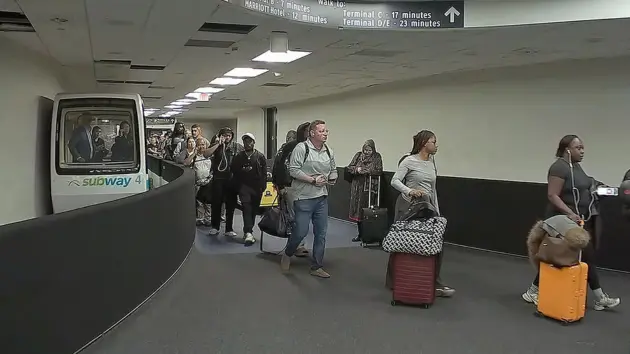
One of the longest security waits on Tuesday was at Bush International Airport in Houston, where travelers stood in a line stretching from the airport subway to the security check-in gates, according to ABC Houston station KTRK.
As of 11 a.m. local time in Houston, the wait time to get through security was estimated to exceed four hours, according to an advisory posted on the Houston Airport System’s website.
The airport disruption in Houston even delayed a member of the National Transportation Safety Board team who was flying to New York’s LaGuardia Airport to investigate Sunday night’s deadly crash between an Air Canada jet and a Port Authority fire truck, NTSB chair Jennifer Homendy said at a news conference on Tuesday.
“Our air traffic control specialist, who was in line with TSA for three hours until we called in Houston to beg to see if we can get her through so we can get here,” she said. “So, it’s been a really big challenge to get the entire team here, and they’re still arriving as I speak.”
Airport security lines are growing nationwide as Transportation Security Administration (TSA) workers, who haven’t received a paycheck for over three weeks, continue to call in sick or quit amid a partial government shutdown over funding for the Department of Homeland Security (DHS).
The TSA reported that about 40% of its workers at Bush airport, whose duties include staffing security lines and running X-ray machines and magnetometers, called out sick on Monday. Houston’s other airport, William P. Hobby Airport, reported that about 40% of TSA personnel called out sick on Monday, according to the TSA.
Across the nation, more than 3,200 TSA officers called out sick on Monday, according to data released by the agency on Tuesday. The numbers weren’t as high as Sunday, when 11.76% of the TSA officers scheduled to work called out sick.
Other major airports were also seeing a high level of absent TSA workers on Monday. John F. Kennedy International Airport in New York and Baltimore-Washington Thurgood Marshall Airport both reported that over 30% of TSA workers called out sick on Monday.
In a statement on Tuesday, Lauren Bis, the DHS acting assistant secretary for public affairs, said the partial government shutdown over DHS funding has caused “more than 450 TSA officers to quit and thousands have called out from work because they are not able to afford gas, childcare, food, or rent.”
Over the weekend, Trump announced he would deploy ICE agents to at least 14 of the nation’s busiest airports to assist TSA workers coping with long security lines.
Those agents began showing up at airports on Monday. The White House’s border czar, Tom Homan, told ABC News on Monday that the agents will be directed by the TSA administrator on how they will best be used to “plug holes in security.”
Both Homan and Trump said the agents will still be responsible for enforcing immigration laws if they come across violations or spot people in the country illegally while at the airports.
Trump said on Monday that if the help from ICE isn’t enough, he’ll deploy the National Guard to airports.
At Hartsfield-Jackson Atlanta International Airport, one of the world’s busiest travel hubs, security lines seemed to be thinning out on Tuesday morning compared to Monday, when lines stretched out terminal doors.
During the peak travel period at 5:30 a.m., ABC News observed a few long lines at Hartsfield-Jackson, but by 7:30 a.m., wait times fell to below normal. But on the airport’s website on Tuesday, travelers were being advised to allow at least four hours or more for domestic and international screening.
Hartsfield-Jackson Manager Ricky Smith told ABC Atlanta affiliate WSB-TV that, with about 40% of the TSA workers calling out sick on Monday, travelers need to allow plenty of time to get through the airport.
“As we progress through this shutdown and call-outs increase, that means TSA can’t process as many passengers as quickly as they can,” Smith said on Monday. “Some passengers are missing flights and so they’re coming in the next day. So, all of that is adding to more congestion, adding to longer lines.”
One traveler, Jason, told WSB-TV that he got to the Hartsfield-Jackson airport seven hours early on Monday for a flight home to Fort Lauderdale, Florida, after waiting at the airport to until 1 a.m. Sunday without ever making it past the TSA security checkpoint.
“I’m already missing a day of work right now, and my bosses are not pleased,” he said.
Democrats have blocked funding for DHS, which oversees the TSA and ICE, in an effort to push for policy reforms at ICE, whose aggressive tactics in enforcing immigration laws have prompted protests and lawsuits across the country.
DHS reforms that Democratic lawmakers have proposed include requiring ICE agents not to wear face masks, be equipped with body cameras and have warrants signed by a judge before entering homes and businesses.
Republicans have, so far, rejected those proposals.
Senators on both sides of the aisle have told ABC News that they are feeling increasingly optimistic that a deal to fully fund DHS is on the horizon.
“We do,” Sen. Katie Britt, R-Alabama, a key negotiator for the Republicans in the DHS funding battle, told reporters on Monday when asked if there was a solution in the works.
Britt’s comments came after she and a group of Republicans met with Trump to discuss a possible solution.
“Democrats and Republicans have been trying to come to some negotiation, and I’m hearing that there is a potential solution,” said Sen. Raphael Warnock, D-Georgia.
The lawmakers are scrambling to find a solution before the end of this week, when they are scheduled to go on recess.
In an interview on ABC’s “This Week” on Sunday, U.S. Transportation Secretary Sean Duffy noted that if a deal is not struck this week, conditions at airports will get worse.
“If this Homeland Security funding isn’t resolved, I think you’re going to see more TSA agents as we come to Thursday, Friday and Saturday of next week, they’re going to quit, or they’re not going to show up,” he said.
On Tuesday, Delta Air Lines announced it is temporarily suspending “specialty services” for members of Congress — including airport escorts — due to resource constraints from the ongoing partial government shutdown.
“Next to safety, Delta’s no. 1 priority is taking care of our people and customers, which has become increasingly difficult in the current environment,” the company said in a statement.
In an interview with ABC News at Los Angeles International Airport on Tuesday, United Airlines CEO Scott Kirby had more bad news for the flying public.
He said consumers should be aware that ticket prices are rising and will need to increase about 20% to cover the surging fuel prices.
As United braces for oil prices potentially reaching $175 a barrel due to the conflict in Iran — it stood at $104 on the global market on Tuesday — Kirby urged travelers to lock in planned trips now to take advantage of current fares. United expects fuel to cost the airline an additional $11 billion year over year.
Kirby said the airline is cutting flights with lower demand to offset the increased costs brought on by the war.
Asked about long airport security lines and the deployment of ICE agents to airports, Kirby said he is heading to Washington on Wednesday to push for TSA funding. He believes a deal is very close and that the issue should be resolved soon.
He noted that, despite calls for airlines to fund the TSA themselves, federal law prevents them from doing so. Still, Kirby said he is confident Congress will approve funding imminently.
The White House didn’t immediately respond to ABC News’ request for comment.
ABC News’ Alex Stone, Ayesha Ali and Steve Osunsami contributed to this report.
Copyright © 2026, ABC Audio. All rights reserved.