



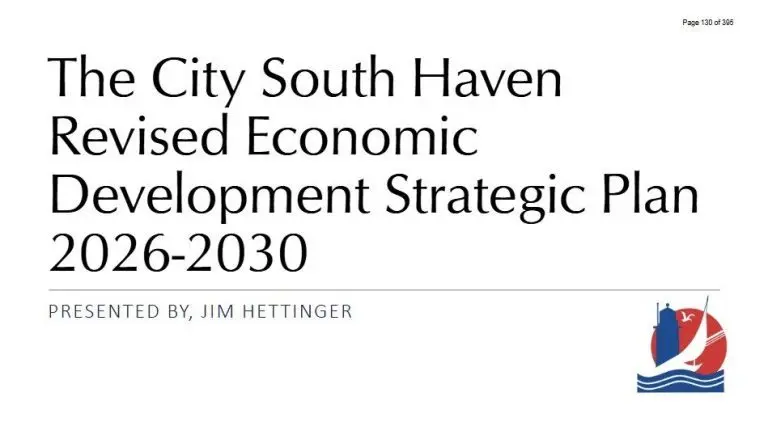
The South Haven City Council has heard a presentation a newly updated Economic Development Strategic Plan for the community.
Speaking at this week’s regular council meeting, consultant James Hettinger told members things are a lot different now than they were when the last plan was drafted. He said there are no longer COVID restrictions in place and the Palisades nuclear plant is now reopening, essentially replacing the jobs lost when it closed.
Hettinger said the city has made good progress on some of its goals, like improving telecommunications for residents and business retention, but challenges remain.
“One of the other initiatives, of course, was to try and build the off-season economy,” Hettinger said. “That has proven to be very, very difficult, and approximately 54% of the houses that we have in South Haven are occupied on a year-round basis. That number drops, of course, when the winter season sets in. So that remains a huge challenge, but we’ve made a little bit of progress there.”
However, Hettinger new market conditions are creating opportunities.
“It’s been our intent to try and improve the housing stock over the past five years to make the remote worker a little bit more at home in South Haven. In West Michigan, we are particularly strong with design engineers.”
And Hettinger said design engineers can often work from anywhere.
Looking ahead, Hettinger recommended shifting away from traditional, population-growth-driven strategies toward non-demographic, or asset-based development. Instead of relying on “build it and they will come,” a new approach should focus on South Haven’s strengths, like its walkable downtown and Lake Michigan access. He also advised engaging older residents, saying they have reliable incomes and time to contribute.
Hettinger told council if it’s going to hire a full-time economic development professional, it had better be for an at least three-year commitment.
Overall, Hettinger concluded that South Haven is in a more optimistic position than in past years, but future success will depend less on attracting new residents and more on smartly using existing assets, strengthening the workforce, and building long-term community wealth.