



State Rep. Joey Andrews says a legal fight over the State of Michigan’s controversial $645 million grant clawback could take months to resolve and may ultimately be decided by the Michigan Supreme Court, with local projects — including Benton Harbor’s State Street Theatre — caught in the middle.
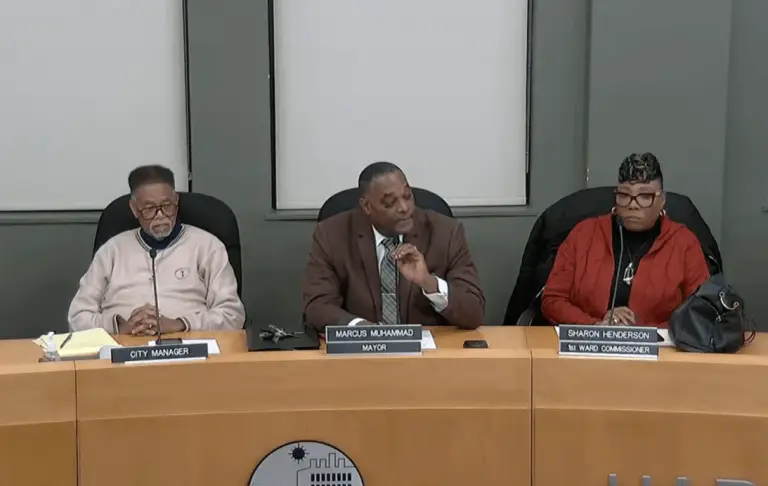
Andrews provided the update this week during a legislative briefing to the Benton Harbor City Commission. The disputed funds were part of a package of legislative enhancement grants that the House Republican Appropriations Committee rescinded unilaterally at the end of last year. Andrews said that pool included funding previously approved for the State Street Theatre project in Benton Harbor.
At the beginning of the year, Michigan Attorney General Dana Nessel issued an opinion declaring the clawback unconstitutional. Andrews said the opinion found the move violated bicameralism by excluding the Senate from the decision, and separation of powers by preventing the governor from directing spending that had already been appropriated by the Legislature.
The House Speaker has since sued to block that opinion, and a court last week issued a temporary restraining order halting further distribution of the funds. Andrews said there was a brief two-week window earlier this year when some grant money may have been released before the order took effect. His office is now working with the state budget office to determine whether any Benton Harbor-related funding was distributed during that period.
“The House Speaker has sued to enjoin that and challenge the Attorney General’s ruling, and the court on Friday granted a temporary restraining order on the further expenditures of those funds. So there was about a two -week period where some money started being distributed, and we’re trying to check and see if any of our grants were in that kind of two -week tranche that went out,” said Andrews.
“Expect an update in the next week or two as we kind of sort through that with the state budget office,” said Andrews.
Andrews cautioned that the case is likely to move slowly through the courts and could take several months to resolve. He said whichever side loses at the trial court level is expected to appeal, making a Michigan Supreme Court review likely. Andrews told commissioners he is confident the grants will ultimately be restored but acknowledged the timeline remains uncertain.
The disputed $645 million includes legislative-directed grants requested by individual lawmakers for projects in their districts. In Andrews’ district, those grants include funding for the State Street Theatre, $500,000 for the Berrien Talent Collaborative’s workforce training expansion, a city hall renovation project in Bridgman, a senior center in Casco Township, and a small business incubator in South Haven. Andrews said some projects have already spent money in anticipation of state reimbursement, creating what he described as a significant gray area if funds are not released.
Broader State Budget Questions
Andrews also addressed broader budget conditions in Lansing, warning local leaders to expect a tighter state budget this year. He said Michigan’s latest consensus revenue estimate projects about $1 billion less in revenue than previously expected for the 2026 budget, due in part to tax changes related to road funding and uncertain economic conditions.
Despite those challenges, Andrews said funding for public safety remains separate from the clawback and is still expected to be distributed, though the current increase is temporary and must be renewed annually until permanent legislation is passed.
Andrews said his office will continue to provide updates as the legal process unfolds and as the state budget takes shape, noting that the outcome will have significant implications for Benton Harbor and other communities awaiting reimbursement for approved projects.